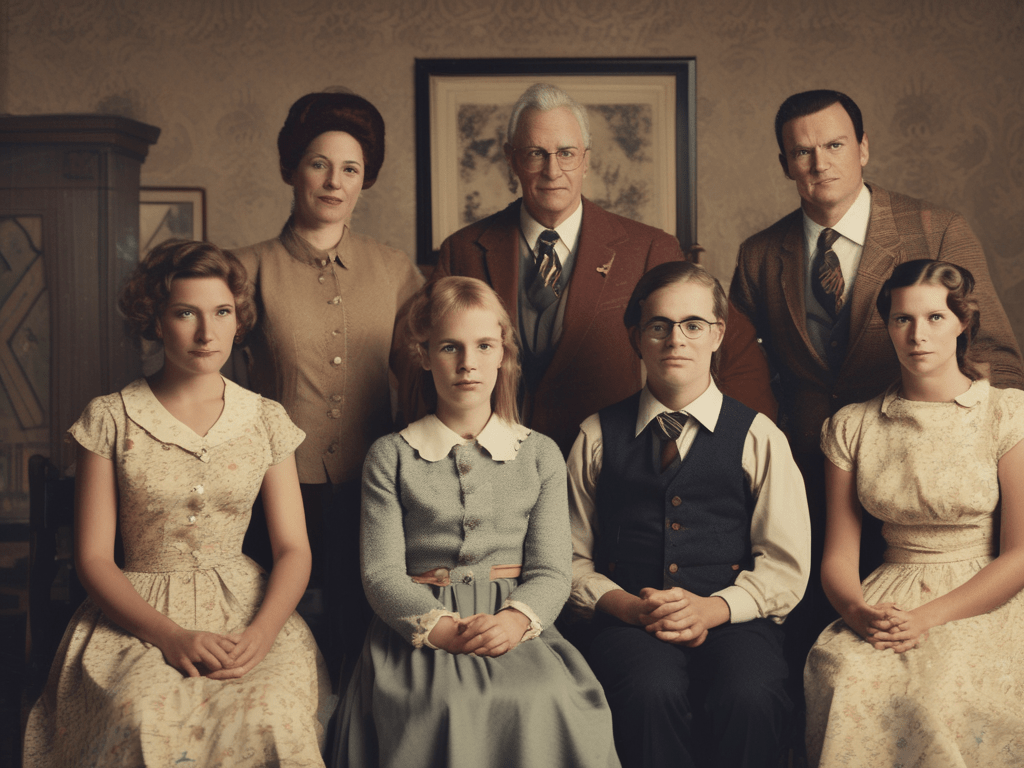
This Be The Verse*
09/05/24
*THIS BE THE VERSE
Philip Larkin
They fuck you up, your mum and dad.
They may not mean to, but they do.
They fill you with the faults they had
And add some extra, just for you.
But they were fucked up in their turn
By fools in old-style hats and coats,
Who half the time were soppy-stern
And half at one another’s throats.
Man hands on misery to man.
It deepens like a coastal shelf.
Get out as early as you can,
And don’t have any kids yourself.
When it comes to families, it’s hard to work out what’s ‘normal’.
The way I see it, when we’re young, because we know nothing else, we assume whatever goes on within our own family is how it is for everyone’s family.
We accept the way we’re treated, what we’re told about ourselves, the place we’re told we hold in the world.
That’s just how things are.
As we get older, we may get to witness how other families function, and we may realise that our own family is different.
Generally, by that stage, we’ve long since been fully trained by the people we’ve grown up around. That kind of foundational training is difficult to undo.
So, although there’s cerebral recognition of our own family dysfunctionality, we continue with the internal, ingrained beliefs about ourselves. We don’t even realise we’re experiencing automatic emotional responses to the way we are treated.
I’ve long since recognised that even when using the term ‘normal’ in the broadest possible way, my family still falls well outside the parameters. It’s dysfunctional and weird.
To be clear, the weirdness of the individual family members mainly falls inside the normal-weird category – human quirks, odd interests, stuff like that. It’s the dynamic within the collective that’s weird-weird
It saddens me that I don’t have an easy, close family unit.
The rare occasions where we come together as a group are so tense and fraught with unnecessary ‘issues’ – from what time and order people might arrive, the takeaway we should get, through to how someone treated the dog and whether to play a board game.
For us, family time is never just a smoothly flowing, fun, loving, sociable occasion.
The thing that’s saddest of all, is that every single family member expresses wishes for things to be different, and yet we’ve failed to make that happen.
I don’t doubt that there is genuine love between us all, but our ability to give and receive it, in a healthy, nourishing fashion, seems beyond our capabilities.
As we reached adulthood, and each of us went out into the world alone, my siblings and I have had fluctuating levels of closeness and contact.
We’ve each faced massive personal issues, rooted in trauma from our childhood, but on the whole have failed to be there for each other. We haven’t by any means, completely failed each other, but there’s been a lack of consistency that, at times, has contributed to our continued emotional distance.
As things currently stand, and I can’t see it changing any time soon, we all have deep love for each other, but have carved off separate relationships.
It’s rare that more than two, three max., of us will get together at any one time.
My brothers, who each live long distances away, will create a timetable/schedule of individual visits with each family member for when they travel here to visit.
Whole family group events are extremely rarely planned.
That’s kinda weird isn’t it?
I tell you what else I find weird – the way that the majority of phone calls between us have to be pre-arranged via text or email.
I mean, I get there being some planning necessary due to work schedules, time zones and such.
However, when one is wanting to just pick up the phone to chat with a relative who literally lives minutes away, and who doesn’t have employment – it seems overly formal to need an appointment first.
Even family gift giving has become this horribly clinical, transactional thing.
At the beginning of December the call goes out and people start to circulate their wish lists. We each pick an item to purchase and gift, then pass the list on.
Sure, I can see that this saves stress for people not sure what to buy, and I can see it avoids those moments of, “Umm…it’s…lovely? what possessed you?!”
But surely that stuff’s all part of the fun? The listening for clues, searching out or stumbling across something you think the person will love.
Even the mad WTF?! presents are all of that is part of the joy for me.
The formality of the gift list makes the whole experience far less sparkly.
So, it appears that for my family, a weird, anxiety filled formality is ‘normal’.
For decades I became trapped in the responses, protections, self-beliefs and harmful coping strategies that I developed as a child, and which became hardened during my teen years.
I trapped myself there, because I didn’t know that my self-image might be warped through the influence of others. Their truth became my truth, and so I acted the way they expected me to – good, bad and ugly.
Later, when I tried to change and be different, other people trapped me there, because… I’m not sure why…
I think the reasons are complex, but believe they ultimately boil down to resistance to change. It’s more comfortable for others when things stay as they’ve always been.
They ‘knew’ me and wouldn’t let me be anything else. And if they didn’t let me be anything different, they wouldn’t have to look at changing anything in themselves.
I think a couple of my immediate family are currently experiencing discomfort with the changes I’m implementing. All the self-therapy, self-care, self-awareness, self-improvement work I’ve undertaken so far this year is bearing fruit.
Most of the changes are probably quite subtle – it’s not like I’m talking about my learnings and new understandings with them anymore. Or raising the past. Or any of the big ‘in your face’ stuff.
However, when people expect you to respond to them in a particular way, because you always have, even subtle changes to the dynamic are felt.
An example: I’ve not been rising to anger about certain comments or incidents as I once would have done. I know that expressing anger to them will inevitably prompt a disapproving, rolling eye comment about Jess “having one of her strops”.
The teenage-me trap.
I now accept that challenging them won’t change things favourably.
The directed anger, and my demands to be better understood are examples of me trying to change people’s behaviour towards me. Fundamentally, that’s fuelled by a need for approval.
I’m teaching myself to bite down on angry responses to these particular family members. Instead, I’m endeavouring to calmly, but quickly, remove myself from the company/call, and to later express the feelings to an understanding friend, or through writing.
Subsequently, I’ve been asked more than once, in that slightly querulous tone people take when they feel slighted in some way, “Are you alright? You ended the conversation very quickly the other day?“
When I’ve lightly said I’m fine, I just needed to (insert excuse), there’s usually been a sceptical, “Hmmm…“
They feel the change, even if they can’t quite put their finger on it, and I get the feeling they’re slightly discomfited.
The thing is, I’ve spent a literal lifetime seeking a particular kind of ‘normal’ in places it doesn’t exist.
Yes, it saddens me that family gatherings are pretty bleak, and our dynamic is so stiff, but that is how it is.
With my family, as with my defunct marriage, it’s time to stop hoping, and pretending, and trying, and bending, in an effort to draw out what isn’t on offer.
I’m not planning to deliberately cut ties or go no communication with any individual, or the collective.
I am determined to be more conscious of the choices I make with regard to how, when and why I have contact with them.
If I stop hoping for change and seeking what’s not available, I’ll stop being disappointed and subsequently being drawn into old, hurt-driven patterns.
By being mindful before, during and after interactions with them, I can continue to make changes to the way I function within the family dynamic.
One notable part of this change is that I’m no longer resenting my family for not being what I wish them to be. Like the rest of us, they’re doing the best they can with what they’ve got.
I’m working on being able to receive what my family can and do offer, knowing it comes from love, even if that love isn’t expressed in the language I prefer.
I’m working on valuing what they’re able to give, without letting my bigger needs tarnish it.
I’m working on being able to give them what they ask for, to a point. The critical part here is changing the cut off point of what, and how much, I give.
Again, as has been demonstrated in other relationships, with my family I’ve generally failed to prioritise my own wellbeing. To do so has felt that I’m being ‘bad selfish’, so I’ve failed to have boundaries.
I inevitably end up feeling a combination of hurt and resentment when my needs are brushed aside by everyone, including myself.
As I continue this journey, expanding my knowledge and trying to be fearless with self honesty, this confusion over ‘good selfish’ and ‘bad selfish’ is slowly shifting. It’s a long way from being totally instinctive, but I’ve reached a point where I can stop, think, and adjust where necessary.
Boundaries. I’m learning to set appropriate boundaries with my entire family.
Well, would ya look at me, having a stab at being all grown up and shit.
JP
 Jessica's Journey
Leave a comment